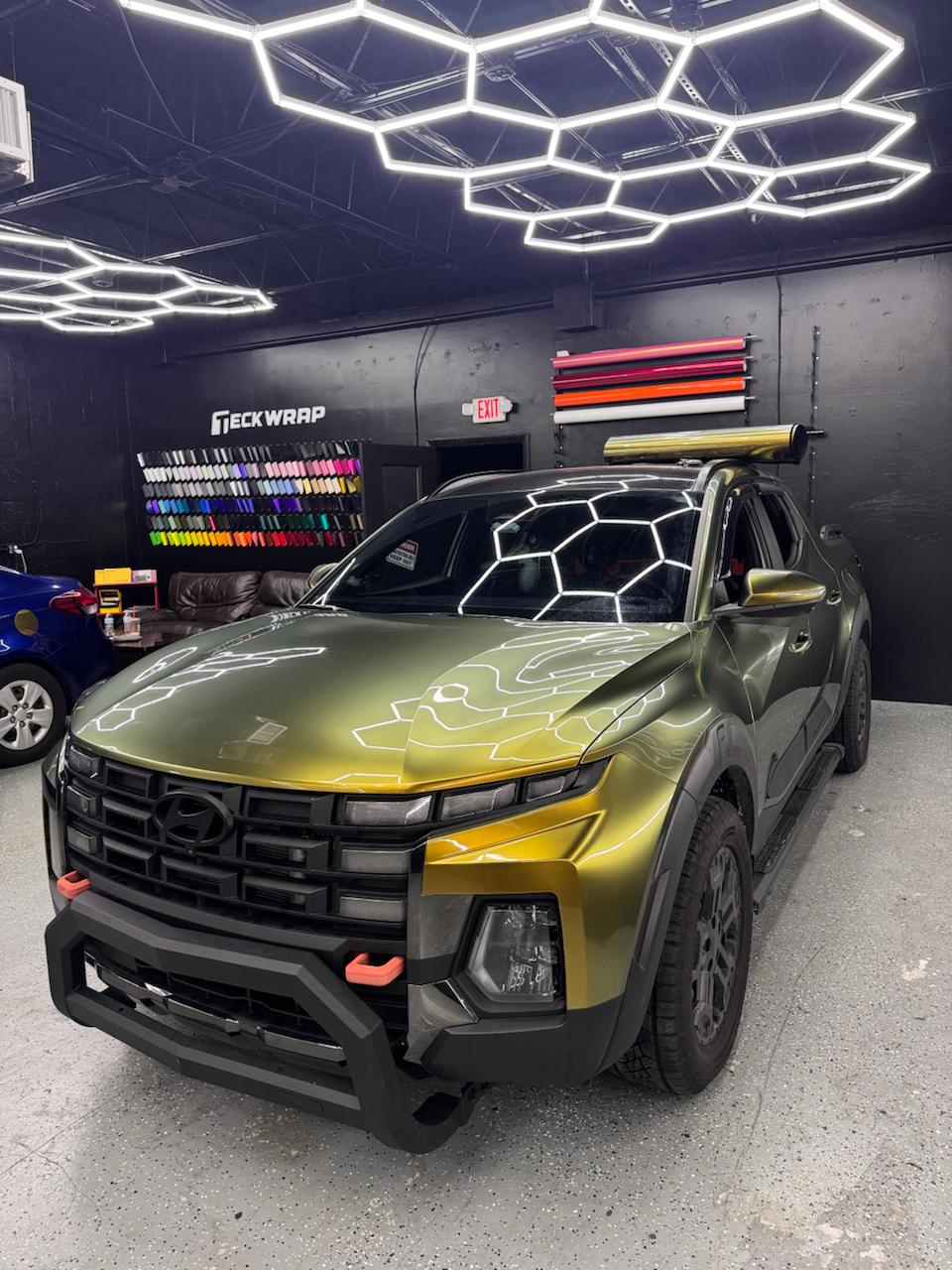
The cross-shop nobody actually explains
You want to change the color of your car, you start researching, and within an hour you've hit two answers that sound almost identical: a color change vinyl wrap or color paint protection film (color PPF). Both transform the look. Both go over your factory paint. Both get pitched as the smart move. And almost nobody slows down to explain how they're genuinely different — or which one fits the car you actually drive around Boca Raton and Fort Lauderdale.
Here's where we're coming from. We install both of these every week. We have no horse in this race — we'll wrap your car in vinyl if that's the right call, and we'll lay color PPF if that's the better fit. What we won't do is push you toward the more expensive option for the sake of it. So this is the honest, studio-counter version: what each one is, what each one costs, how each holds up under South Florida sun, and a simple set of rules to decide.
What Each One Actually Is
Color change vinyl is a conformable PVC film with a colored, pigmented top layer and an adhesive back. It's built to stretch over curves, tuck into edges, and give you a completely new finish — gloss, satin, matte, metallic, color-shift, brushed, you name it. Vinyl is a style-first product. Its whole reason to exist is the look, and the catalog of looks is enormous.
Color PPF is paint protection film with the pigment built in. It's the same tough, self-healing polyurethane that clear PPF is made from — the stuff installed on hoods and bumpers to stop rock chips — except it comes in a color or finish instead of clear. So it does two jobs at once: it changes how the car looks and it shields the paint underneath like real PPF.
The one-liner we give people at the counter: vinyl is a finish that happens to protect a little; color PPF is protection that happens to be a finish. Keep that framing and most of the decision gets easier.
Side-by-Side: Color PPF vs Color Change Vinyl
| Feature | Color PPF | Color Change Vinyl |
|---|---|---|
| Typical lifespan | 8–10 years | 5–7 years |
| Paint protection | PPF-grade — absorbs rock chips and road impact | Cosmetic — light scuff/UV barrier only |
| Self-healing | Yes — light swirls vanish with heat | No — scratches stay |
| Removability | Removable by a pro; protects paint while on | Removable by a pro; clean off quality paint |
| Color / finish selection | Growing, but still narrower | Massive — hundreds of colors and finishes |
| Relative cost | Higher | Lower |
That table is the short version. The rest of this post is the why behind each row, because the right answer depends entirely on your car and how long you plan to keep the look.
What Each One Costs
We're not going to throw fixed numbers at you, because a quote that ignores your specific vehicle, the coverage you want, and the film tier you choose isn't a quote — it's a guess. What's true across the board: color PPF costs more than color change vinyl. You're paying for a thicker, tougher film and a more demanding installation.
But before you write off PPF on price, do the full-cost math. A lot of color-change clients also want clear PPF on the high-impact panels — hood, front bumper, mirrors, fenders — to protect that fresh look from chips. When you stack a vinyl wrap plus front-end clear PPF, the total can land a lot closer to a color PPF job that already does both at once. So the real comparison isn't "vinyl vs color PPF" on the sticker; it's total cost of look-plus-protection, and that's where the gap narrows.
Every car is different, so the only honest way to compare is on your actual vehicle. Get a free quote — pricing depends on coverage, film tier and vehicle, so we'll give you an exact number for both options side by side.
One more thing worth saying plainly: the cheapest quote is rarely the cheapest job over the life of the car. A bargain vinyl that fails in two years under our sun, or a rushed PPF install that lifts at the edges, costs you twice — once to put it on and again to fix it. We price the work to last, and we tell you up front which panels matter most so you can spend where it counts.
Lifespan in the South Florida Sun
This is where Boca Raton and Fort Lauderdale change the conversation. Our UV load is relentless — cars baking in surface lots at Town Center at Boca, parked all afternoon along Las Olas, sitting in the open at Mizner Park or Royal Palm Place, running up and down A1A and I-95 in full sun. That heat and ultraviolet exposure is the single biggest factor in how long any film lasts here.
Two things matter most. First, horizontal panels go first. Hoods, roofs, and trunk lids take the most direct sun and the most heat, so that's where finishes fade or degrade earliest regardless of which product you pick. Color PPF's thicker, more UV-stable construction generally holds up longer on those panels, which is a real part of why its lifespan range runs higher.
Second, film tier matters more than the category label. A premium vinyl from a top manufacturer will outlast a bargain-bin vinyl by years, and the same is true across color PPF lines. When we quote you, we'll be specific about which film we'd use and why — because in this climate, the tier you choose is often a bigger deal than vinyl-versus-PPF.
Self-Healing: The Weekly Difference
Here's a difference you'll actually feel week to week. Color PPF is self-healing. Light swirl marks, fine wash scratches, the little marks that come from drive-thru car washes and daily use — they soften and disappear when the film warms up in the sun or under warm water. In a place where your car sits in heat every day, that healing happens almost on its own.
Vinyl doesn't do that. A scratch in vinyl is a scratch in vinyl — it stays. For a daily driver that lives outside in Boca or Lauderdale, that single trait is often what tips someone from "I just want the color" to "actually, I want the color PPF." Not the spec sheet — the lived experience of a finish that keeps looking fresh with less fuss. After a few months of Florida driving, that difference adds up: the color PPF car still reads as new, while a vinyl daily picks up the fine marks of ordinary life.
Color Libraries: Where Vinyl Still Rules
If you came here for a specific look, vinyl probably wins on selection, and it's not close. The vinyl catalog is enormous: 3M 2080, Avery Dennison, Inozetek, KPMF and more give you hundreds of options — gloss, satin, matte, metallics, color-shift, brushed metal, textured finishes. If you've got an exact shade or an exotic finish in mind, vinyl is built to deliver it.
Color PPF's library is growing fast — XPEL, STEK, and SunTek all keep expanding their color and finish lineups — but it's still narrower than vinyl. So the honest trade-off is this: vinyl gives you almost unlimited creative range; color PPF gives you protection with a solid and improving menu of looks. If your dream finish only exists in vinyl, that may settle it on its own.
Resale Impact
For owners thinking about resale, the framing flips depending on the product. Color PPF protects the factory paint underneath the whole time it's on the car. When it comes off — or stays on — the original paint has been shielded from chips and UV, which is a genuine plus for a higher-value vehicle you intend to sell well.
Quality vinyl, professionally installed and professionally removed from healthy factory paint, also comes off clean and leaves the paint as it was. The risk with either product is the same: cheap film, a rushed install, or peeling it off yourself. Done right by a pro, neither one is a resale liability — and color PPF can be a resale asset on a car where the paint itself is the value.
One practical note for sellers in Boca and Lauderdale: keep your paperwork. If you registered a manufacturer warranty on qualifying film, hold onto it — a documented, professionally installed protective film is a selling point to the right buyer, and it shows the car was cared for rather than neglected in the sun.
Decision Rules
Cut through all of it with these. Match yourself to the line that fits:
Keeping the car 5+ years, parked outside → Color PPF
Long-term ownership in full South Florida sun rewards the longer lifespan, self-healing, and paint protection. This is color PPF's sweet spot.
You want a niche color or exotic finish → Vinyl
If the exact look you want lives in a vinyl catalog and nowhere else, vinyl is the answer. Selection wins.
Lease or 2–3 year ownership → Vinyl
For a shorter horizon, you don't need a decade of life or maximum protection. Quality vinyl gives you the look for the time you'll keep the car, at a lower cost.
High-value car, paint-as-asset → Color PPF
When the factory paint is part of what the car is worth, the protection color PPF provides is worth the premium.
Budget is the constraint → Quality vinyl
If price is the deciding factor, don't reach for the cheapest possible job — reach for a quality vinyl from a top manufacturer, properly installed. That's the best look-per-dollar without setting yourself up for early failure.
FAQ
Does color PPF look as good as vinyl?
On gloss and most popular finishes, color PPF looks excellent — deep and glassy, often indistinguishable from a great vinyl. Where vinyl still pulls ahead is the sheer breadth of specialty finishes (color-shift, certain matte and textured looks). For mainstream colors, you'd be hard-pressed to tell them apart.
Can I just put clear PPF over a vinyl wrap instead?
We don't recommend layering clear PPF over color vinyl. It adds cost and complexity, the two films don't always play nicely long-term, and removal gets messier. If you want both color and PPF-grade protection in one, that's exactly what color PPF is for — it's the cleaner solution than stacking products.
Is a color change legal in Florida?
Yes — changing your car's color with wrap or color PPF is legal. Florida does ask you to keep your registration accurate, so update your vehicle's color with the DMV after a color change. It's a quick administrative step, and we're happy to point you in the right direction.
How much maintenance does it need in South Florida?
Both are low-maintenance, but our climate has opinions. Wash regularly to clear off pollen, salt air, and bug residue, use a gentle pH-neutral soap, and avoid harsh automatic brushes — hand or touchless washing is kindest to either finish. Color PPF's self-healing makes it more forgiving of daily wash marks. Keeping the car out of relentless direct sun when you can extends the life of any film here.
Will either one damage my factory paint?
Not when the paint is healthy and the work is done by a pro. Both quality vinyl and color PPF install over and remove from sound factory paint cleanly. The damage stories almost always trace back to cheap film, sloppy installation, paint that was already failing, or a DIY peel. Done correctly, both protect the paint while they're on.
Bring us the car
The fastest way to settle vinyl versus color PPF is to put your actual vehicle in front of us. We'll show you finishes for both, talk through how long you plan to keep the car, and quote both options side by side so you can decide with real numbers — no pressure, no upsell.
We're a 5.0★ Google-rated studio with certified installers, dealership-grade prep, and manufacturer warranties registered on qualifying films, serving drivers across Boca Raton and Fort Lauderdale.
Get your free quote or contact us to book a look. Call or text (646) 240-9847 — we're open Mon–Fri 9–7 and Sat 9–5. See our work on Instagram @wrap.me.usa. Whether it ends up vinyl or color PPF, we'll get the look right and built to last in the South Florida sun.
.jpeg)